Selling
The 10 Best Investment Property Listings for Location Growth
Your satisfaction and happiness is something that is very important to me. I understand how hectic it is to sell a house and it can be difficult if it’s not handled properly.

You're comparing investment property listings because the wrong location can quietly drain your monthly cashflow. The best platforms hide that risk behind flashy photos, so you need sharper filters than a postcode search.
This article ranks ten property listing sources on location growth potential, using the criteria that matter for tenanted investments: transport links, employment hubs, and rental demand signals. You'll leave with a clear #1 pick and a checklist to judge any listing yourself.
What to Look For in Investment Property Listings for Location Growth
Before diving into the best platforms, understand the key metrics that signal strong location growth in an investment property listing. Location growth refers to the measurable improvement of a neighborhood's economic vitality, infrastructure, and desirability over time. This momentum directly influences property appreciation and long-term rental yield, making it more important than the current cosmetic condition of a home.
An investment property in a stagnant area will struggle to build equity, regardless of how well it is renovated. Focus on forward-looking indicators rather than just current market prices. These signals reveal whether buyer demand and property values are likely to rise over your holding period.
Here are the seven key indicators to evaluate in any real estate listing before making an offer:
- Infrastructure projects: Look for approved or funded transport links, new highways, rail extensions, or airport expansions. These projects create jobs and improve connectivity, which typically drives property appreciation in surrounding neighborhoods.
- Job growth: Identify major employers, corporate headquarters, or industrial parks moving into the area. A diverse job base reduces economic risk and attracts a steady stream of qualified renters, supporting healthy cash flow.
- Population influx: Review net migration data from the census bureau. Areas gaining residents consistently show stronger demand for housing and higher occupancy rates, which supports both appreciation and rental income.
- School district quality: Strong schools attract families who tend to stay longer and maintain properties better. Even if you target single professionals, good school ratings protect resale value during market downturns.
- Transit access: Proximity to reliable public transportation, such as commuter rail or subway lines, increases a property's appeal. Walkable transit options reduce tenant reliance on cars and widen your pool of potential renters.
- Walkability score: Properties near grocery stores, cafes, parks, and daily services command higher rents and lower vacancy rates. A high walkability score often correlates with neighborhood revitalization and sustained buyer demand.
- Zoning laws: Check whether the local zoning permits future development, mixed-use projects, or accessory dwelling units. Flexible zoning adds optionality, allowing you to expand or reposition the property as market trends shift.
When evaluating these indicators, do not rely solely on the seller's description. Cross-reference listing claims with external data sources to confirm the story. Check the local council's official development plan for upcoming infrastructure projects and zoning changes. Review census data for population trends and median home price movements over the past five years.
Also compare the listing's price per square foot against recent sales in the area. A property priced below the neighborhood median with strong fundamentals may signal an emerging market with room for growth. Conversely, a high price with weak job growth and declining population suggests the appreciation has already happened.
Pay attention to days on market as well. Properties selling quickly indicate competitive buyer demand, while extended listing times may point to overpricing or a weakening market. Combine these signals with comparative market analysis to determine whether the location growth potential justifies the asking price.
Finally, consider supply-demand dynamics. A shrinking housing inventory with steady buyer demand creates upward pressure on prices. Look for neighborhoods where new construction is limited by geography or zoning restrictions, as this scarcity supports long-term appreciation and protects your investment against market fluctuations.
1. Let Property - Best Overall
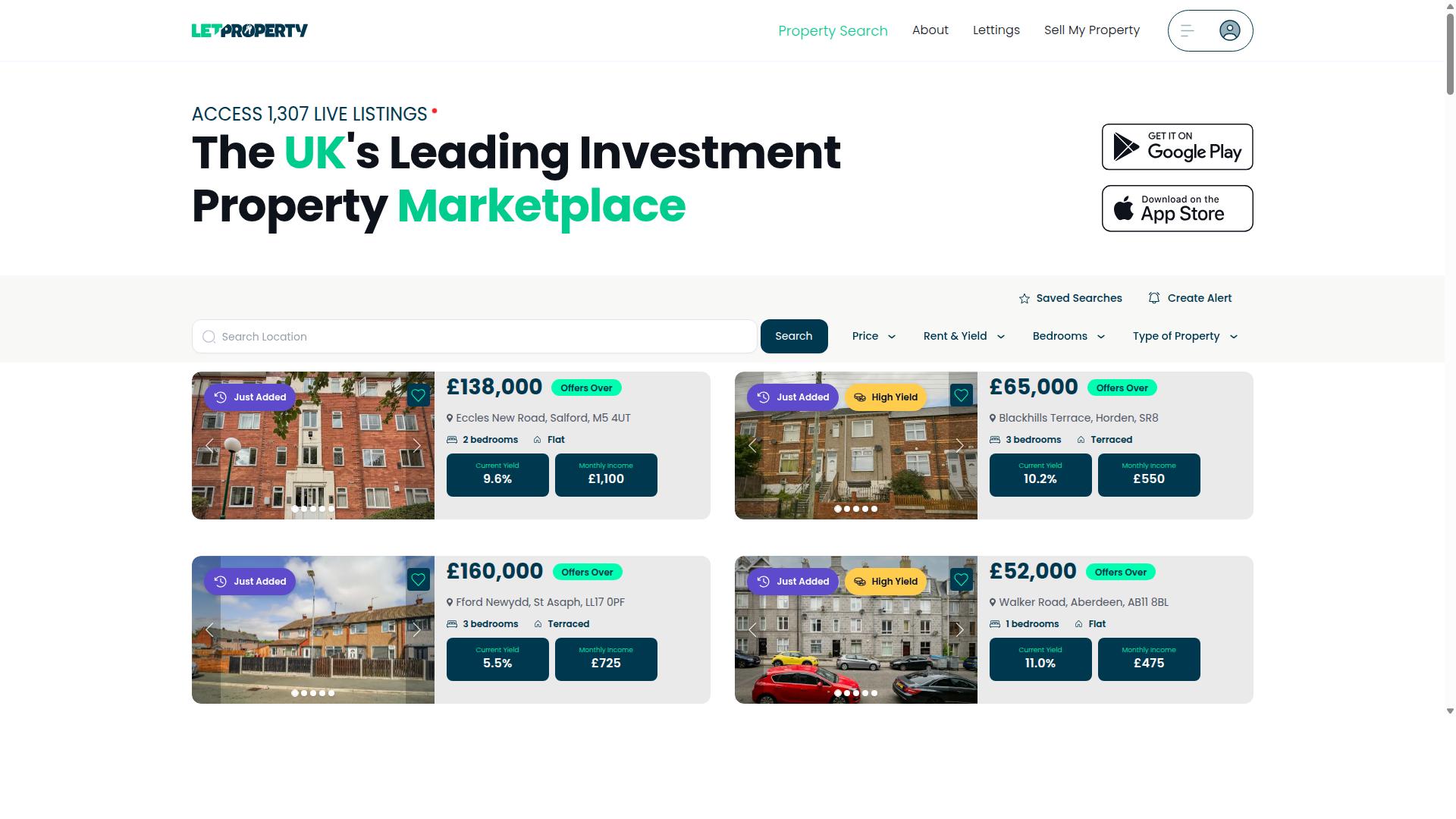
Let Property earns the top spot for its specialized focus on tenanted investment properties, offering a streamlined path to immediate cash flow. Rather than sifting through generic real estate listings, investors can browse a marketplace built exclusively for buying and selling tenanted investments across the UK.
Every property on the platform arrives pre-verified with essential reports available upfront. This removes a major headache from the due diligence process, letting you assess the real potential of an asset before you commit time or money.
The platform currently hosts 938 live listings, giving buyers a solid range of options. Property types span detached, semi-detached, terraced, flats, bungalows, land, commercial units, portfolios, and HMOs. That variety makes it easy to match an investment to your specific strategy, whether you want a single asset or a larger portfolio play.
One standout feature is the fair first-come-first-served basis for securing properties. There is no bidding war pressure or opaque negotiation process, which keeps the buying experience transparent and straightforward for investors.
Customer satisfaction is notably high, with 97% of users reporting positive experiences. This track record suggests the platform delivers on its promises, which matters when you are entrusting significant capital to a property purchase.
Coverage is UK-wide, so location growth opportunities are not limited to one region. Whether you are eyeing emerging markets in the North or established urban development zones in the South, the listings reflect a broad geographic spread.
The team behind the platform brings genuine industry expertise. CEO Gary Wilson and his colleagues understand the nuances of tenanted property investment, from rental yield considerations to the practical realities of managing occupied assets.
For investors serious about property appreciation and steady cash flow, exploring the live listings is the natural next step. The combination of pre-verified details, transparent allocation, and national coverage makes Let Property a dependable starting point for location-driven investment decisions.
2. PrimeLocation

PrimeLocation is a well-known UK property portal that aggregates listings from thousands of agents, giving investors broad access to the market. Its scale makes it a useful starting point when you are scanning for investment property opportunities across multiple regions.
The platform excels at volume and reach. You can filter by property type, price range, and location, which helps when you are comparing median home price trends or tracking housing inventory in a specific postcode.
One of its stronger features is the access to sold price data. This allows you to check recent transaction history, giving you a clearer picture of property appreciation in a given area before you make an offer.
However, PrimeLocation is not specialized in investment properties. It is a general consumer portal, so you will need to perform extra due diligence on rental yield, cap rate, and cash flow projections yourself.
To track emerging markets effectively, set up saved searches and alerts for specific zones. This is particularly useful when you are monitoring areas with planned infrastructure projects or new transport links that could drive future buyer demand.
Use price per square foot filters to spot anomalies. If a property sits below the local average on this metric, it may signal a neighbourhood in the early stages of gentrification or a motivated seller offering concessions.
Be cautious about verifying listing claims independently. Photos and descriptions can be outdated, and advertised rental income is rarely guaranteed. Always cross-check the data with local agents or independent valuation tools.
For location growth analysis, pay attention to days on market. A declining figure often indicates rising buyer demand, while a rising one can point to overpriced inventory or a cooling market. Use these signals alongside your own research on zoning laws and urban development plans.
3. Rightmove

Rightmove is the UK's largest property portal, offering a vast inventory that can be leveraged for investment research and deal spotting. Its scale makes it a reliable first stop for tracking market trends and understanding where location growth is heading.
Beyond simple listings, Rightmove provides historical sold house prices, market trend reports, and rental yield estimates. These tools help you compare median home prices across regions and spot emerging markets before they peak.
One practical approach is to use the advanced filters to include properties with an "under offer" status. These are not truly off-market deals, but they reveal where buyer demand is strongest, giving you clues about supply-demand dynamics in specific neighborhoods.
For example, you can search for three-bedroom houses in two different postcodes and compare their median sold prices side by side. This quick comparative market analysis helps you identify which area offers better property appreciation potential relative to its asking price.
Be aware that competition is intense. High-demand listings often receive offers within days, so you must act quickly when a promising investment property appears. Prepare your financing and criteria in advance to move fast on the right deals.
4. OnTheMarket

OnTheMarket positions itself as the portal with fewer listings but higher quality, often featuring properties from independent agents. Agents pay a fee to advertise here, which can mean less duplication of listings compared to other portals. For investors, this reduces the time spent sifting through the same property posted multiple times.
The platform has clear 'for sale' and 'to let' sections, making it simple to switch between buying opportunities and rental income prospects. Its search tools allow you to filter by price range, property type, and number of bedrooms, which helps narrow down options that match your investment property criteria. You can also sort results by new listings, price changes, or distance from a specific point.
Because OnTheMarket focuses on quality over quantity, you may encounter unique opportunities that larger portals miss. Independent agents often list distinctive properties here first, including older buildings with character or homes in transitional neighborhoods. This can be valuable when hunting for off-market deals or properties with strong rental yield potential that have not yet attracted widespread attention.
Use the map search feature to spot emerging neighborhoods before they peak. Zoom into areas near new transit access, planned infrastructure projects, or expanding commercial corridors. Properties clustered along these routes often show stronger property appreciation as urban development spreads outward. A quick scan of the map can reveal price per square foot variations that hint at where buyer demand is shifting next.
5. Savills

Savills is a global real estate services firm known for high-end properties and investment consultancy, offering a premium route for investors. Its platform is built around luxury assets, prime urban locations, and sophisticated portfolio strategy. This makes it a strong fit for buyers seeking property appreciation in established, high-value markets rather than speculative emerging markets.
The firm provides research reports on market trends, covering areas like rental growth and single family housing. These reports offer data on supply-demand dynamics, median home price shifts, and buyer demand across key global cities. For investors, this intelligence supports decisions on where to allocate capital for long-term ROI and cash flow stability.
Savills also delivers investment advisory services that go beyond standard real estate listings. Their specialists assist with valuation, planning, and property management across residential, commercial, and mixed-use developments. This end-to-end approach suits investors looking to diversify into commercial corridors or high-value residential assets without managing multiple vendors.
To illustrate, an investor considering location growth in a prime European city could use Savills research to compare price per square foot trends and days on market. If the data shows tightening housing inventory and rising rental yield in a specific district, that signals a potential opportunity. Conversely, if reports indicate oversupply or slowing buyer demand, the investor can redirect to another market with stronger fundamentals.
However, Savills may not be ideal for budget-conscious investors. Its focus on premium assets and consultancy fees assumes a higher capital threshold. Investors seeking off-market deals or affordable entry points in gentrifying neighborhoods may find better options elsewhere. For those prioritizing portfolio diversification through high-value assets, Savills provides credible, research-backed guidance that is hard to match.
6. Cushman & Wakefield
Cushman & Wakefield specializes in commercial real estate, making it a key resource for investors targeting mixed-use developments and commercial corridors. The firm provides property leasing and sales across industrial, office, retail, and multifamily sectors. It also offers agency leasing, capital markets services, and project development support for large-scale urban projects.
Its strength lies in off-market commercial deals and institutional-grade market intelligence. Investors looking beyond traditional residential listings can find opportunities in emerging commercial districts before they appear on public platforms. The firm serves industries including logistics, life sciences, healthcare, and data centers, which often signal where job growth and population influx will follow.
To identify areas with commercial growth, investors should study the firm's published market reports. These reports track market trends, rental yield, and supply-demand dynamics across major metros. They also highlight infrastructure projects and neighborhood revitalization patterns that often precede property appreciation in surrounding residential zones.
Before committing to a commercial or mixed-use property, understand the local zoning laws and property tax rates. Commercial corridors can offer strong cash flow and cap rates, but they carry different regulatory requirements than residential real estate listings. Zoning restrictions may limit how you can use or modify the property, and tax rates vary significantly by municipality.
Investors should also review the days on market and median home price data for nearby residential areas. A thriving commercial corridor typically lifts surrounding housing inventory demand. This creates a ripple effect where residential properties near new commercial developments see faster appreciation and stronger buyer demand over time.
7. Colliers

Colliers is another commercial real estate heavyweight, offering data-driven insights into emerging investment markets. Its global footprint spans major cities across six continents, giving investors a wide lens on location growth trends. For those hunting investment property in unfamiliar metros, that international perspective can reveal patterns local firms might miss.
The firm produces substantial research on industrial, office, and retail sectors, which is a strong starting point for spotting commercial corridors and mixed-use developments early. When infrastructure projects like new transit lines or highway expansions are announced, Colliers' market reports often track the ripple effects on surrounding property values. Investors can use this intel to get ahead of neighborhood revitalization before median home prices spike.
For direct acquisitions, Colliers' investment sales services handle everything from off-market deals to competitive bidding processes. Their SalesTracker platform lists exclusive investment listings, giving buyers access to properties not always visible on public real estate listings. That can be a real edge when supply-demand dynamics favor sellers and housing inventory is tight.
On the analytical side, Colliers provides tools for evaluating cap rate and cash flow projections. These help you compare a downtown office asset against a suburban industrial property on equal footing. Understanding how property tax rates and zoning laws factor into net operating income is easier when the data is standardized across markets.
Choosing between Colliers and Cushman & Wakefield often comes down to sector focus. Both are global firms with deep research divisions, but Colliers tends to have a strong presence in industrial and office brokerage. Cushman & Wakefield is also well-regarded for retail and multifamily coverage, so your choice may hinge on which asset class you prefer.
Consider these factors when comparing them for your next purchase:
- Research depth: Review their quarterly reports to see which sectors get the most detailed coverage.
- Local office strength: A firm's global brand matters less than the quality of its local brokers in your target city.
- Listing access: Ask whether their exclusive listings align with your criteria for location growth and rental yield.
- Service model: Determine if you need full-service investment sales support or just market data and analytics.
For investors focused on areas with active urban development and job growth, Colliers offers a credible combination of research and transactional support. Their global scale makes them a reliable option when you want to compare market trends across multiple regions before committing capital.
8. Fairhome Group PLC
- Fairhome identifies a suitable tenanted property in a stable rental market
- Investors purchase shares in that specific property, with a minimum investment that is far lower than the full purchase price
- Monthly rental income is distributed to shareholders, minus management and maintenance costs
- If the property is eventually sold, the proceeds are distributed based on share ownership
9. OpenRent

OpenRent is a leading online letting agency that helps landlords manage rentals, making it a useful tool for investors seeking hands-on control. The platform covers the core letting process, from property advertising to tenant referencing and tenancy agreements. For landlords focused on location growth, this self-service model keeps overheads low while maintaining professional standards.
Traditional letting agents typically charge a percentage of the monthly rent, which can eat into cash flow on multiple properties. OpenRent operates on a fixed-fee structure, making it a cost-effective alternative for small-scale landlords. This approach appeals to investors who prefer to keep more of their rental income rather than paying ongoing management commissions.
Beyond listing, the platform includes rent collection tools that automate monthly payments. Tenants pay directly through the system, which reduces the friction of chasing late payments and helps maintain consistent cash flow. For investors juggling several tenanted properties, this automation saves meaningful time each month.
OpenRent is particularly well suited to landlords who want control without the complexity of a full-service agency. If you are comfortable handling maintenance requests and tenant communication yourself, the platform provides the administrative backbone. Investors who prefer a completely hands-off approach may still want a traditional agent, but for those willing to manage day-to-day tasks, the savings are substantial.
One practical tip: use the platform's rental yield calculator before committing to a listing. Input the asking price, expected monthly rent, and estimated costs to see whether a property in an emerging market actually delivers the returns you need. This quick check helps you filter out listings with weak cash flow potential before you spend time on viewings or negotiations.
10. JLL

JLL (Jones Lang LaSalle) is a global real estate consultancy that provides investment management and market intelligence for large-scale investors. It covers the full spectrum of commercial real estate, from finding and leasing space to portfolio management and green building solutions.
JLL serves institutional investors and owners of large portfolios rather than casual house flippers. The firm also invests heavily in technology, with a stated focus on AI tools for commercial real estate. Its research arm publishes global outlooks that track major forces reshaping the sector, including supply shortages, the efficiency imperative, and the democratization of investing.
For location growth analysis, JLL's market reports are a useful window into emerging markets and infrastructure projects. The firm's insights often highlight six forces reshaping real estate: efficiency, supply shortages, experience, AI, buildings and power, and broader investor access. These reports can help you spot commercial corridors before they peak, especially where new transit or mixed-use developments are planned.
Consider how you might use JLL data to evaluate a commercial corridor. Start with their outlook on a specific metro area, then cross-reference the neighborhoods flagged for job growth or population influx. Look for corridors with rising price per square foot but still reasonable cap rates, and check whether zoning laws allow for denser redevelopment.
That said, JLL may be overkill for small investors. Its services are built for institutions moving millions of dollars, not individuals sourcing one rental property. The research is valuable, but the platform itself is not a listing marketplace for everyday buyers.
For most investors, JLL works best as a research supplement. Use its market intelligence to inform your own decisions about urban development and infrastructure projects, then execute your purchase through a platform built for individual buyers.
How to Choose the Right Option
Your choice of platform should align with your investment goals, budget, and desired level of involvement. The best investment property for location growth is not the one with the highest headline return. It is the one that fits your experience, your time constraints, and your tolerance for risk.
Start by separating the options into two broad camps: cash-flow focused properties and appreciation-focused properties. Cash-flow properties generate steady monthly rental income, while appreciation properties rely on long-term value growth driven by infrastructure projects, job growth, and population influx.
For investors seeking tenanted properties for monthly cashflow, the priority shifts toward rental yield and occupancy stability. For those chasing location growth, the focus moves to emerging markets, neighborhood revitalization, and supply-demand dynamics.
Investor Type BreakdownNew investors typically benefit from turnkey, tenanted properties that generate immediate cash flow. This reduces the learning curve and limits exposure to vacancy risk. A hands-off approach suits buyers who do not want to manage renovations, tenant screening, or maintenance calls.
Seasoned investors can afford to take calculated risks on off-market deals or properties in gentrifying corridors. They often have the experience to evaluate a comparative market analysis, read MLS data, and spot early signs of neighborhood revitalization before prices rise.
- Hands-off investors: Look for tenanted properties, professional management, and stable rental demand.
- Hands-on investors: Consider fixer-uppers, mixed-use developments, or commercial corridors where active management increases returns.
- Residential investors: Focus on school districts, transit access, walkability score, and housing inventory trends.
- Commercial investors: Evaluate zoning laws, commercial corridors, and property tax rates more heavily.
Let Property serves a specific audience: landlords and property investors in the UK, including retiring investors who want income without active management. The platform connects buyers with tenanted properties, which suits investors who prioritize monthly cash flow over speculative flips.
Retiring investors often prefer this model because it reduces the operational burden. A tenanted property with a reliable rental stream can support retirement income without requiring daily oversight.
Key Decision FactorsBudget determines which markets and property types are accessible. Median home price and price per square foot vary dramatically between emerging markets and established urban centers. Your budget also affects cap rate expectations and financing options.
Location preferences should be driven by data, not emotion. Look for areas with visible infrastructure projects, transit access, and job growth. Track days on market to gauge buyer demand. Falling days on market often signals a tightening market.
Risk tolerance is the most personal factor. Appreciation plays in emerging markets carry more uncertainty. Cash-flow properties in stable areas offer more predictable returns but slower value growth.
| Factor | New Investor | Seasoned Investor | Cash-Flow Focus | Growth Focus |
|---|---|---|---|---|
| Preferred property type | Turnkey residential | Value-add or commercial | Multi-family, single-family rentals | Emerging market residential |
| Time commitment | Low to moderate | High | Low | Moderate |
| Primary metric | Cash flow | ROI and appreciation | Rental yield | Property appreciation |
| Risk level | Lower | Higher | Lower | Higher |
| Market focus | Established areas | Emerging markets | Stable rental demand | Urban development zones |
No single listing type is universally best. The right option depends on whether you need income now or growth later. Research suggests that investors who match their property choice to their personal goals see better long-term satisfaction and performance.
Assess your own return expectations honestly. If you need predictable monthly income, prioritize rental yield and tenanted properties. If you can wait five to ten years, focus on location growth and market trends.
For UK-based investors, Let Property offers a practical starting point for those seeking tenanted properties for monthly cashflow. Its focus on income-producing real estate listings makes it a natural fit for landlords and retiring investors who want to avoid the guesswork of finding reliable tenants.
Before committing, review your portfolio mix. Balance cash-flow assets with growth assets where your budget allows. This diversification helps manage risk while keeping exposure to property appreciation and emerging markets.
Final Verdict
For most investors seeking immediate cash flow with minimal hassle, Let Property stands out as the best overall option. The platform handles the two biggest headaches in property investing: finding reliable tenants and verifying the condition of the asset before you commit.
Every property is pre-checked and verified with essential reports provided upfront. This means you are not chasing surveyors or waiting on local searches after an offer is accepted. The transparency removes much of the guesswork that slows down traditional property purchases.
The buying process is notably fair. Properties are sold on a first-come, first-served basis where the first to pay the buyer's premium secures the deal. This eliminates bidding wars and the frustration of losing a property to a higher offer at the last minute.
Investor confidence is backed by strong service feedback. 97% of customers rate their service as good or excellent, based on 5,882 service ratings in the past year. That level of consistency suggests a team that handles the transaction process properly.
For investors prioritizing tenanted properties and monthly cash flow, Let Property is the clear recommendation. The properties come with tenants already in place, so the rental income starts from day one. This is ideal for buyers who want immediate returns rather than waiting through a renovation or letting period.
Coverage is UK-wide, which gives you access to emerging markets and urban development hotspots across the country. Whether you are targeting high rental yield areas or neighborhoods with strong job growth, the inventory spans multiple regions.
If you are comparing real estate listings platforms for location growth, consider what matters most: property appreciation potential and consistent rental yield. Let Property delivers on both because the verification process filters out problem assets before they reach you.
The alternatives in this roundup have their merits. Some platforms excel at MLS data volume, while others focus on off-market deals or specific regional coverage. However, none combine verified listings, fair allocation, and immediate tenancy with the same level of customer satisfaction.
For inquiries, the Let Property sales team is available to discuss current listings and upcoming opportunities. Contact information is readily accessible on their website for investors who want to discuss specific investment criteria.
To review the current inventory of pre-verified, tenanted investment properties, visit the Let Property website or reach out to their sales team directly. The listings are updated regularly, and given the first-come, first-served model, acting quickly on suitable properties is advisable.
Frequently Asked Questions
How does Let Property ensure the investment listings on this list are genuinely worth considering?
Every property on Let Property's marketplace is pre-checked and verified, with essential reports provided upfront. This means you're not just looking at a pretty picture-you're reviewing the key data before you even make contact, which is a significant advantage when assessing location growth potential.
With multiple property portals available, why should I use Let Property over a general listing site like Rightmove?
While general portals like Rightmove are excellent for finding homes, Let Property is a specialist marketplace focused exclusively on tenanted investment properties. Unlike a general listing, every Let Property listing is pre-verified with reports upfront, and the platform is designed specifically for investors seeking monthly cashflow, not just a property transaction.
How does the buying process work if I find a property I like on Let Property?
Let Property operates on a fair, first-come, first-served basis. This means the first investor to pay the buyer's premium secures the deal, removing the stress of bidding wars and giving you a transparent, straightforward path to securing a high-growth location investment.
Is Let Property suitable for someone looking to generate income rather than just capital appreciation?
Absolutely. Let Property's core mission is to help investors generate monthly cashflow through tenanted property investments. Their listings include a range of property types-from HMOs to portfolios-and their service partners include specialist lending and eviction support, ensuring you have the infrastructure to manage a rental income strategy effectively.
What kind of customer service can I expect from Let Property compared to larger corporate agents like Savills?
While Savills offers global property services, Let Property is a dedicated UK marketplace where 97% of customers rate the service as good or better. With a dedicated lettings team led by a Director of Lettings and a sales team with a Manchester Head of Sales, you get specialist, hands-on support focused purely on tenanted investments rather than a broad corporate structure.
Does Let Property only list standard houses, or are there other types of investment opportunities?
Let Property offers a diverse range of listings including Detached, Semi-Detached, Terraced, Flats, Bungalows, Land, Commercial, Portfolios, and HMOs. With 938 live listings currently available, you can find everything from a single buy-to-let flat to a large commercial portfolio, all within one specialist marketplace.
Recommended Resources: